The marketing funnel remains the cornerstone of strategic customer acquisition and retention in today’s hyper-competitive marketplace. Rooted in 20th-century theory yet continuously evolving, the marketing funnel describes the customer journey prospects undergo, mapping routes from initial brand awareness to becoming loyal advocates. This classic model, simple in design but complex in its execution, helps us visualize the movement of potential customers through various touchpoints. By employing comprehensive marketing strategies, we nurture interest and gradually transition prospects from the initial stages to the decisive purchasing stage, ensuring a seamless flow from awareness campaigns to conversion and beyond.
At its fundamental level, the sales funnel helps us organize efforts to improve every part of the customer journey. Each phase demands meticulous design: from robust lead generation at the top, through diligent lead nurturing in the middle of funnel, to delivering exceptional customer service after a sale. We strive to optimize the conversion rate by leveraging data and adjusting our approach based on Google Analytics insights, ensuring that no potential customers are lost unnecessarily. Accurate interpretation of Key Performance Indicators allows for practical and careful analysis and ongoing adjustments, propelling sustainable and measurable results.
Understanding Each Stage of the Marketing Funnel
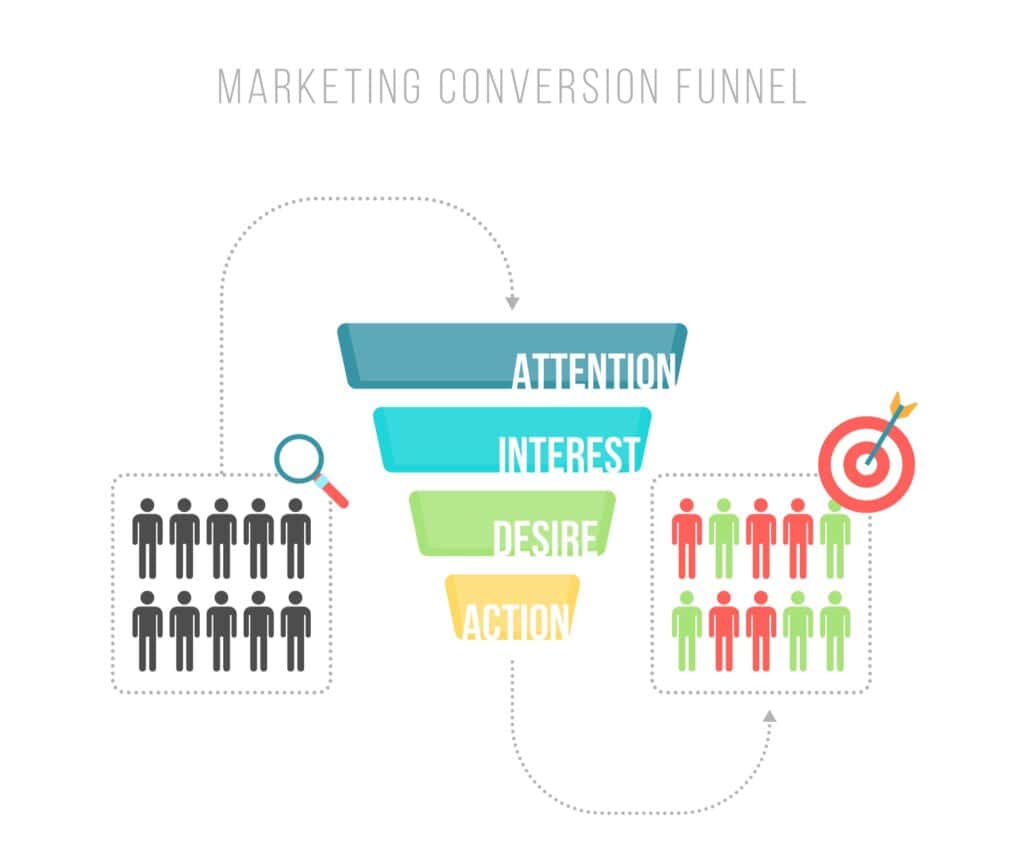
The marketing funnel typically consists of three main stages: awareness, consideration, and conversion. In the top section, also referred to as the lead generation phase, we deploy content marketing initiatives and awareness campaigns to capture the attention of receptive individuals. At this stage, messaging resonates through strong social media strategy templates, targeted ads, and engaging blog posts that help build stronger brand awareness among both B2C clients and B2B consumers. The main objective is to seamlessly introduce the brand, decreasing the risk of buying for first-time visitors.
As we progress to the middle of funnel, the decision process intensifies. During this critical period, our focus is on thorough lead nurturing by providing educational resources, including case studies, customer testimonials, detailed guides, and interactive webinars. This approach strengthens future interactions by addressing the unique needs of diverse user personas and establishes the credibility necessary for B2C customers and B2B customers alike. A compelling product page becomes a vital tool here, enriched with genuine social proof and real-world examples that reassure and motivate potential customers toward action.
The final stage is all about nudging leads through routes to conversion. Clarity of messaging and urgency through a persuasive call to action ensures a simple purchasing process. Tools like email retargeting, discounts, and a visible loyalty program add tangible value, while direct communication with sales representatives or a company representative often seals the deal in B2B Marketing Funnels. Whether engaging B2C segments online or B2B organizations through personalized outreach, we constantly monitor Click-through rate and online sales as vital indicators of success.

Optimizing the Funnel Through Content and Personalization
Delivering value at each phase of the marketing funnel is the biggest benefit of well-crafted marketing strategies. At the top, content marketing initiatives engage prospects with informative articles and videos that clarify complex problems or introduce cutting-edge solutions. As prospects reach the middle of funnel, we nurture leads with comparative guides, customer testimonials, and endorsements from respected industry authorities, ensuring our brand appears as a trusted choice. As leads move closer to making a decision, transparent pricing, clear return policies, and a focus on customer service enhance confidence and reduce friction.
Using Google Analytics, we track micro-conversions and identify drop-off points, adjusting tactics for better performance. Sophisticated segmentation enables us to tailor messaging and offers to distinct customer base segments, whether addressing individuals or broader groups, such as B2B customers who typically require longer nurturing cycles. Every email interaction, website visit, and social media engagement shapes the ongoing relationship, reinforcing the effectiveness of our marketing funnels and mapping routes for current and future marketing funnels.
Measuring and Refining Funnel Performance
Sustaining successful marketing funnels demands persistent measurement and optimization. Through a detailed examination of Key Performance Indicators (KPIs), such as conversion rate, Click-through rate, and Customer Acquisition Costs, we obtain actionable insights into the effectiveness of each segment. We utilize Google Analytics and custom dashboards to track progress, ensuring clear attribution from initial contact to sale. Through A/B testing, heat mapping, and continuous review of sales funnel drop-off points, we ensure that the distinct elements of the funnel deliver the right message at the right time, minimizing leakage and maximizing results.
Competitive advantage stems from a careful analysis of case studies and social proof, which demonstrate tangible returns and value to stakeholders. An in-depth understanding of customer interaction touchpoints, from website visits to personal consultations with sales representatives, further enhances our ability to cater to B2B consumers and B2C customers with precision.

Adapting the Funnel for Omnichannel and Modern Consumer Behavior
Modern marketing strategies must account for vast changes in consumer habits and expectations. Today’s user personas expect a consistent experience across every interaction, whether through content marketing, email interactions, or dynamic product page presentations. We utilize CRMs and omnichannel analytics platforms to ensure continuity and quality across every communication channel, enabling faster resolution and more personalized conversations—a necessity for both B2C and B2B environments. The integration of loyalty programs not only rewards repeated engagement but also increases the lifetime value of our customer base by closing the loop between initial purchase and future interactions.
Conclusion: The Marketing Funnel as a Dynamic Growth Engine
The benefit of marketing funnels is their adaptability and their structured guidance for every stage of the customer journey. Employing a unified, data-driven approach drives higher conversion rates, streamlines the decision process, and provides clarity for both our teams and our potential customers. While there isn’t a single model to guarantee success, the continuous evolution of future marketing funnels ensures long-term competitiveness and relevance. By understanding and mastering these sequential steps, from awareness to advocacy, we foster brand loyalty, achieve superior results, and reduce wasted effort—solidifying our brand as a leader in an era defined by dynamic customer expectations and relentless change.